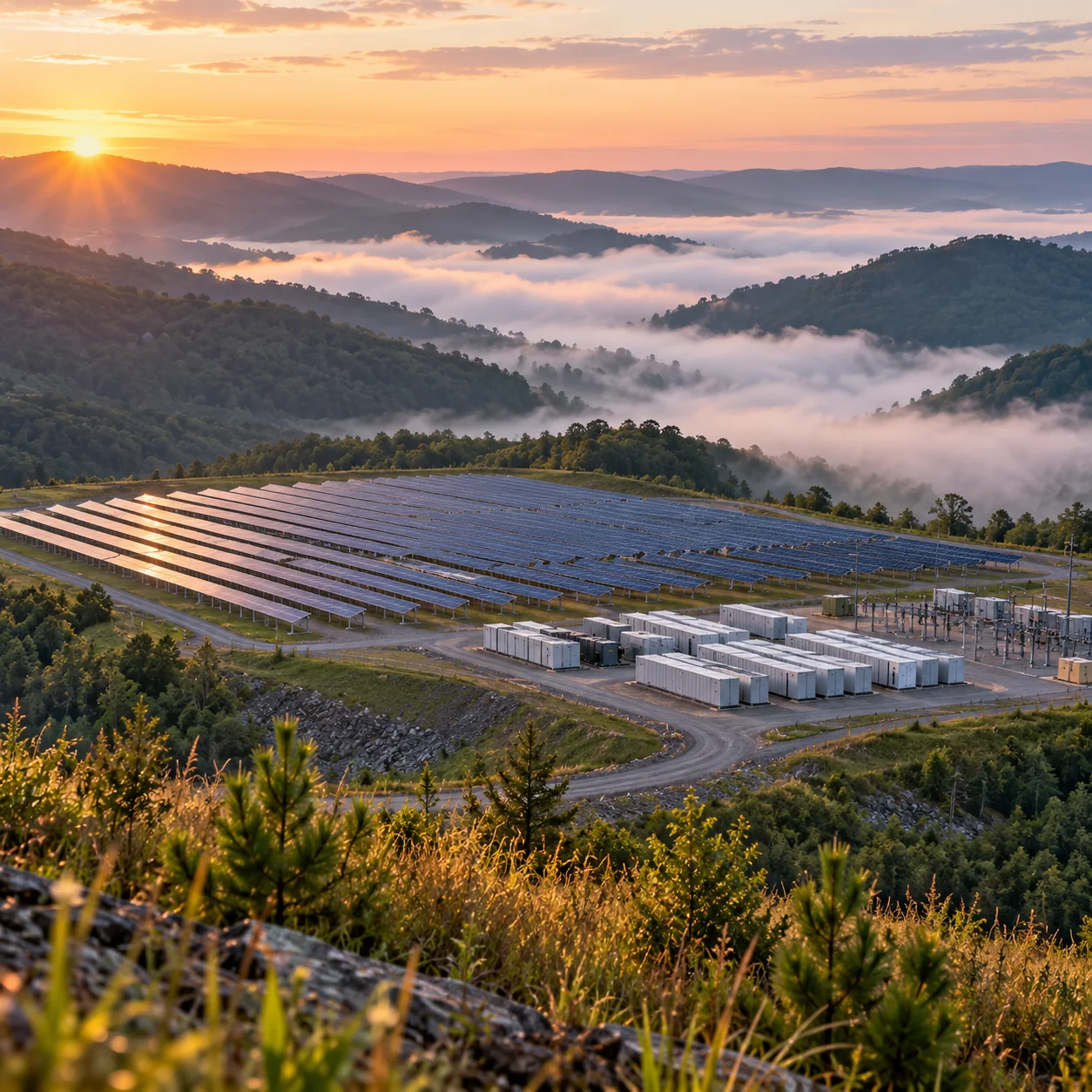
A reclaimed coal mine in West Virginia is about to show what data center power buying looks like when solar on its own is no longer enough.
On September 2, MN8 Energy, Google and Eos Energy Enterprises announced a collaboration around Mammoth Solar, a project in Kanawha County that pairs 86 MW of utility-scale solar with 70 MW/280 MWh of lithium-ion storage and 10 MW/100 MWh of Eos’ Z3 zinc-based long-duration storage. According to pv magazine USA, Google will buy the project’s energy, capacity and clean energy attributes under a long-term agreement.
How the project is put together matters as much as its size. MN8 says it custom-designed the plant as an integrated system that turns intermittent solar output into a single, dispatchable resource for the PJM grid. That is a different product from a conventional solar power purchase agreement, and it shows where large-load buyers are heading.
A Solar Project Designed to Behave Like Firm Supply
The two storage layers do different jobs. The lithium-ion block, at four hours of duration, covers the evening ramp as solar output falls away. The Eos Z3 system is designed to deliver 10 hours of storage, according to the companies, keeping solar energy available long after the panels stop producing.
Together they let one interconnected asset serve far more of the day than its panels could alone.
That change matters.
The build is phased. The solar component is planned to begin commercial operation in 2028, with the lithium-ion storage following in 2029 and the long-duration system in 2030. MN8 puts the capital investment at up to $350 million, with around 200 construction jobs and roughly $4 million in property tax revenue for the county and its schools over 20 years.
Data Center Buyers Are Now Paying for Hours, Not Just Megawatt-Hours
Google framed the deal in terms of capacity rather than green credentials alone. Lucia Tian, the company’s director of advanced energy technologies, said Google is committed to backing solutions that both serve its data center capacity needs and accelerate progress toward cleaner, more affordable energy systems. ESS News reports that Google described the goal as deploying a portfolio of round-the-clock technology solutions for its digital infrastructure.
For hyperscalers, matching annual consumption with renewable purchases is no longer the hard part. The hard part is showing grid operators, utilities and regulators that new load comes with resources that help during the hours when the system is tight. pv magazine USA reports that Mammoth Solar is tailored to Google’s regional data center load profiles, including a planned West Virginia facility.
What is a megawatt of solar worth to a grid operator at 9 p.m.?
And what is it worth if it can still deliver at 3 a.m.?
PJM Needs Resources That Show Up When Called
PJM is where the pressure from data center load growth shows most clearly, and dependable capacity is the scarce commodity. As more solar gets built, its output piles up at midday. A hybrid plant that can be dispatched through the evening and overnight offers a kind of value that standalone solar is steadily losing.
Eos chief commercial officer Nathan Kroeker made the point directly: “The grid needs more from every megawatt of new generation.” Stacking solar, short-duration and long-duration storage behind a single project gets more useful energy out of each point of interconnection. In a region where queue positions and grid capacity are hard to secure, that is a practical advantage.
It also changes who carries the cost of firming. A large customer paying for a dispatchable profile takes on part of the reliability burden that would otherwise land on utility planners and, in the end, on other ratepayers.
Long-Duration Storage Gets a Commercial Foothold in Appalachia
The deal is Google’s first project using Eos’ Z3 technology, and the companies say it will be West Virginia’s first commercial-scale long-duration energy storage deployment. For a technology class that has spent years trying to move from pilots to bankable contracts, a long-term offtake from a creditworthy hyperscaler is the kind of signal that lenders notice.
Kroeker described the aim as “deploying American-made long-duration storage where it solves real grid reliability challenges.” Domestic manufacturing, a reclaimed industrial site and a new local tax base also give the project a political story that plays well in coal country.
For developers, utilities and investors following the project, the open questions are practical ones:
- How the lithium-ion and zinc blocks are dispatched together in PJM markets
- Whether capacity accreditation rewards the 10-hour system for its duration
- How the Z3 system performs at commercial scale once it comes online in 2030
- Whether the phased 2028 to 2030 schedule holds through procurement and construction
- Whether other large-load buyers copy the customised hybrid contract model
The Template Other Large Loads Will Study
MN8 chief executive Jon Yoder described the project as a reflection of “understanding a customer’s unique energy profile and building a solution around it.” That sums up the commercial shift. Offtake is moving from standard products to resources designed around how a particular load actually behaves.
For utilities, that is a useful development. Large customers who arrive with firmed, dispatchable supply are easier to plan around than customers who arrive with only a load forecast. For developers, the opportunity is to sell shaped capacity instead of commodity energy, and to price it accordingly.
For long-duration storage providers, the message is plain: the first buyers willing to pay for duration are the ones whose growth depends on it.
Solar is what puts the old mine back to work. Storage is what will make it count when the grid needs it most.