The basic distribution transformer has changed little in generations. A megawatt of power electronics now suggests it does not have to stay that way.
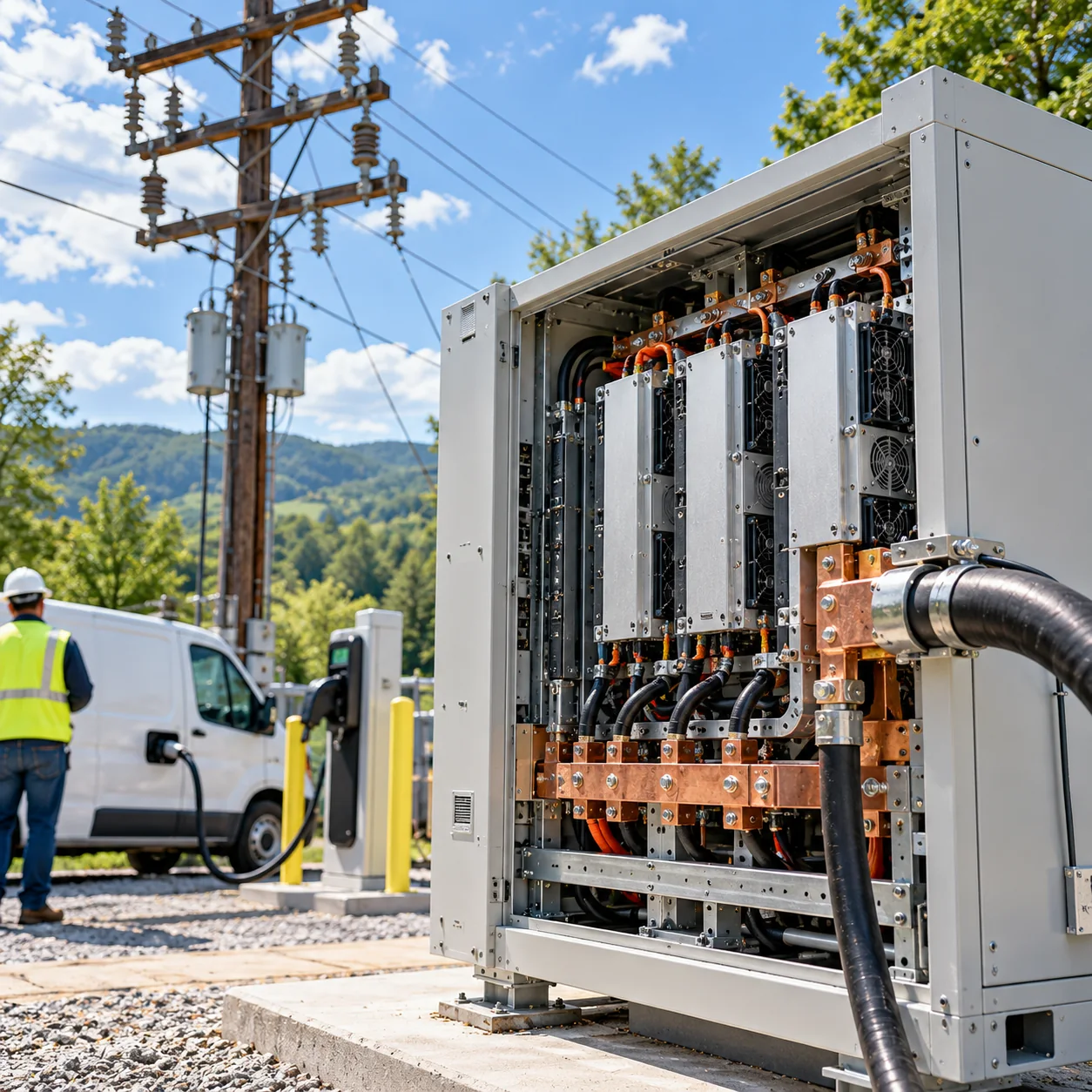
On September 8, POWER published a detailed account of a field campaign in which North Carolina State University, the New York Power Authority and EPRI connected a 1-MVA solid-state transformer to a live 13.2-kV utility distribution feeder at EPRI’s power delivery laboratory in Lenox, Massachusetts. Over three days in mid-June, the NC State-built unit supplied power to an electric vehicle load, injected reactive power for grid support and was energized and de-energized at least 10 times.
Srdjan Lukic, the NC State professor who led the hardware work, told POWER it is “the first independently verified, megawatt-class solid-state transformer validated on a live utility distribution feeder.” The partners first announced the result in mid-August. The POWER account adds detail on what was proven, what was not, and where the technology goes next.
That matters because the distribution transformer sits at exactly the point where the grid is under the most new pressure.
A Transformer That Behaves Like a Grid Asset
A conventional distribution transformer does one job: it steps voltage up or down. A solid-state transformer does that with power electronics, and in the process takes on functions that today require separate equipment. According to POWER, it can deliver AC or DC output, control real and reactive power at the grid interface and support bidirectional flow.
The Lenox test showed several of those functions working on a real feeder. “We demonstrated that not only can we deliver real power to the vehicle, but we can also deliver reactive power back to the grid,” Lukic said. He added that power quality was “quite high in terms of the harmonic distortion.”
For Ramadan Elmoudi, who led the project at NYPA, the simpler milestone carried weight too. “You can be able to connect and disconnect and see the impact on the grid. That’s very crucial,” he told POWER.
Stacking Modules Solved the Voltage Problem
The obstacle for SSTs at distribution voltage has always been the semiconductors. NC State’s answer, as POWER describes it, was a modular architecture that connects multiple smaller power-electronic modules in series on the medium-voltage side so the feeder voltage is shared across them, paired with a custom isolation transformer.
Individual module efficiency “peaks out at about 98%,” Lukic said. NC State’s August release, carried by T&D World, put the comparison in plain terms: conventional transformer-and-rectifier systems lose about 4% of power, while the SST loses about 2%.
The work has been a long build. NYPA and NC State began collaborating in 2018, with initial funding from the Department of Energy’s Transportation Technologies Office. Lukic noted that many of the components in the current system “were simply not available, even kind of in the research realm” when earlier prototypes were built.
Data Centers Are the Obvious First Market
Asked where commercial demand will come from, Lukic was direct: “The big one, of course, is data centers that everyone is talking about.”
The logic is simple. Data centers need DC power and today convert from the AC grid through layers of equipment. An SST that combines voltage transformation and AC-to-DC conversion in one unit cuts conversion steps and floor space. “SSTs take up less space,” Lukic said in the August release, which “can be important when considering large-scale projects such as data centers.”
EV charging, battery storage, renewable integration and microgrids also appear on the list of applications POWER cites. Each is a load or resource that wants DC, fast control, or both.
For utilities facing large new loads, a transformer that can also manage reactive power and respond to grid conditions starts to look less like a passive component and more like a controllable asset.
That change matters.
Standards Come Before Utility Purchase Orders
Nobody involved claims the job is finished. EPRI has characterized SST technology as “largely in pilot or prototype stages,” and POWER is clear that moving beyond a three-day campaign means qualifying the equipment for the conditions utilities expect medium-voltage gear to withstand over decades of service. The open items are specific:
- Standards for design, build, testing, commissioning and maintenance, which do not yet exist for SSTs
- Through-fault and short-circuit survivability
- Tolerance of lightning and switching surges
- Thermal cycling and accelerated aging
- Communications and cybersecurity
- Cost and interoperability with existing utility equipment
“I believe the next big step is going to be standardization because we don’t have any standards for SST,” Elmoudi said. Lukic framed reliability the same way: the industry has to reach “a device where the end user has confidence that these units will last as long as a traditional transformer.”
NC State and NYPA do not plan to commercialize the unit themselves. Elmoudi’s call is for industry to step in: “We need to expose this to industry and invite them to invent and collaborate in this project.”
The Opening Belongs to Manufacturers and Early Utilities
That invitation is the real opportunity. Transformers have been a persistent pressure point for US grid buildout, and an SST draws on power electronics rather than only on traditional wound-core manufacturing. A credible, independently tested design gives manufacturers a reference point and gives utilities a reason to fund pilots and start drafting specifications.
“I think in terms of commercialization, the proof of concept is there,” Lukic said.
The utilities and vendors that engage early will shape the standards everyone else ends up buying against. NYPA has already drawn its own conclusion. In Elmoudi’s words, solid-state transformers “can serve as another tool in our clean energy toolbox.”
The proof of concept has run on a live feeder. Now the industry has to write the rulebook that lets it stay there.