The distribution grid is getting a nervous system.
On October 13, Itron and Pacific Gas and Electric Company announced that their work on grid edge intelligence for wildfire mitigation is moving from a proof of concept to a scaled pilot, with thousands of Itron sensing endpoints deployed in high fire-risk areas of PG&E’s service territory.
The aim is to find the electrical warning signs of a failing line or transformer early enough for crews to act before those conditions turn into an outage or an ignition.
From Proof of Concept to Thousands of Devices
The rollout is staged. According to the companies, first installations are underway in the Santa Cruz area. The first phase plans for about 3,000 devices in high fire-risk communities, with roughly 10,000 planned through 2027.
The longer horizon is far larger. PG&E plans to scale to hundreds of thousands of devices by 2030.
That trajectory is what separates this from a lab exercise. A few sensors can prove the physics. Thousands of them, spread across real circuits in varied terrain, prove whether the approach works operationally.
The work is partly funded through PG&E’s electric research budget under California’s Electric Program Investment Charge, the state’s program for testing new grid technologies before wider adoption.
Seeing the Fault Before It Becomes a Fire
Most utilities learn about a distribution fault when a protective device operates or a customer calls. By then, the damage has often happened.
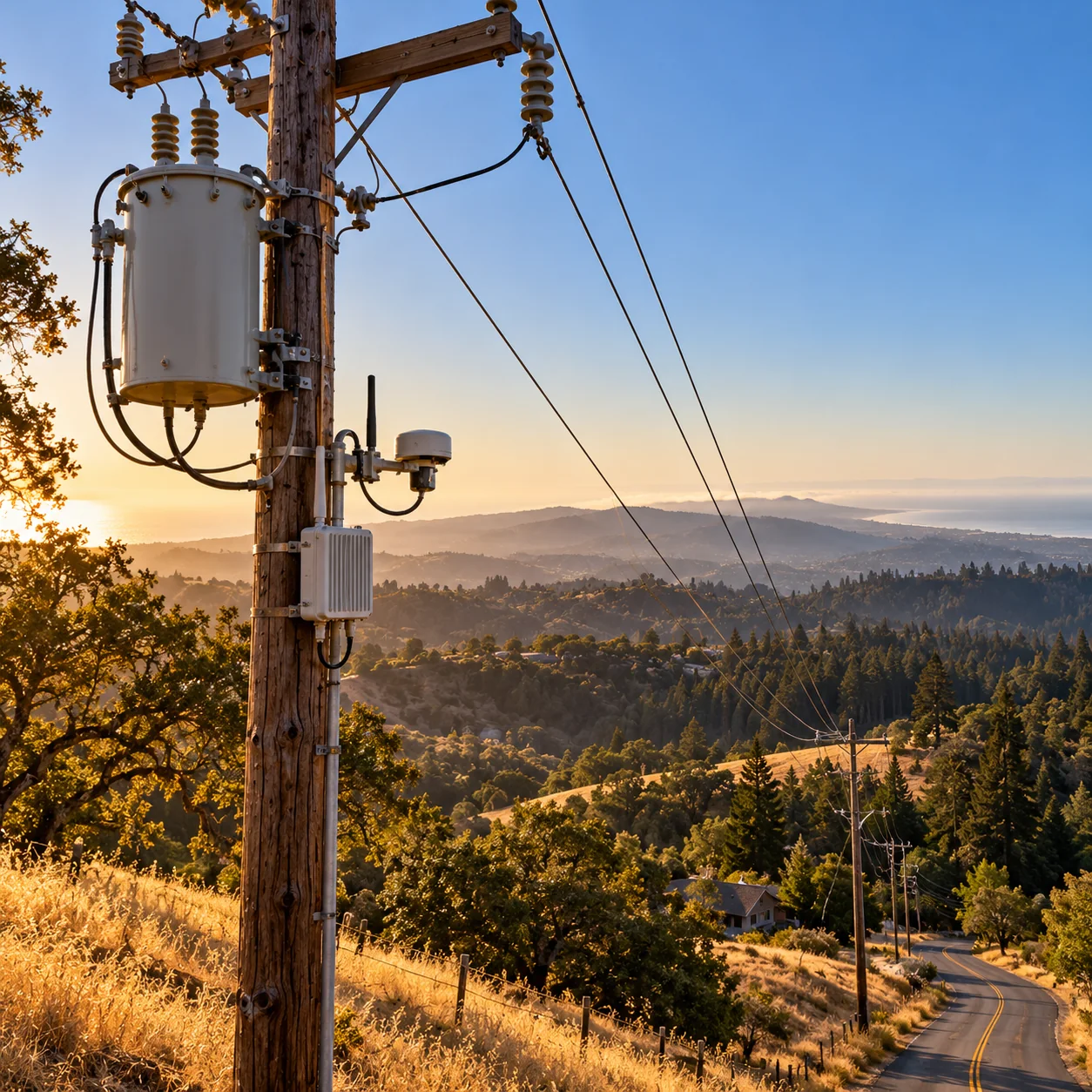
Itron’s endpoints are designed to work earlier in that chain. The devices capture electrical waveforms, communicate with one another peer to peer, and run analytics at the edge. Together, those capabilities are used to detect, classify and locate fault indicators on medium-voltage circuits and on the low-voltage segment between the transformer and the home.
The companies say the system can:
- Narrow down where on a circuit a fault is developing
- Classify fault types such as insulation degradation, equipment overload and failing conductors
- Flag emerging risks before they become outages
- Reduce false positives that send crews out unnecessarily
That last point is easy to overlook. Every unnecessary truck roll costs money and pulls crews away from real work. Better classification makes field response both faster and cheaper.
Why Continuous Monitoring Fits Wildfire Country
Wildfire mitigation has leaned heavily on periodic inspection, vegetation management and, in the worst conditions, shutting power off. Those tools remain necessary, but each has limits. An inspection is a snapshot. A shutoff protects against ignition at a heavy cost to customers.
Continuous electrical monitoring adds a different layer. It watches the condition of the system all the time, from the inside.
Craig Kurtz, senior director of continuous monitoring at PG&E, said the approach lets the utility detect and locate problems earlier so it can act before they cause outages or ignitions.
For a utility with a large high fire-risk footprint, the ability to rank which circuits and which segments need attention first is a meaningful operational gain.
Reliability Gains Beyond Fire Season
The benefits do not switch off when the fire season ends.
Don Reeves, senior vice president of outcomes at Itron, said the technology addresses risks before they become outages or wildfire threats and can help improve SAIFI and SAIDI, the standard reliability metrics that track how often customers lose power and for how long.
That gives the investment a dual case. It reduces ignition risk in dry months and supports reliability performance year round.
For regulators weighing cost recovery, a technology that improves both safety and reliability is easier to justify than one that serves a single purpose.
What Other Utilities Should Watch
Utilities across the West face the same mix of aging distribution assets, rising wildfire exposure and pressure on rates. The PG&E pilot will generate the kind of evidence they need.
The key questions are practical. How accurately does fault classification match what crews find in the field?
How much earlier does detection happen, and how many outages or ignitions does that prevent?
Answers at the scale of thousands of devices, and eventually hundreds of thousands, will show whether grid edge sensing can become standard distribution infrastructure rather than a specialist add-on. They will also inform how utilities plan data handling, crew dispatch workflows and integration with existing outage and asset management systems.
The grid edge has long been the part of the network utilities could see least. PG&E and Itron are betting that is about to change.