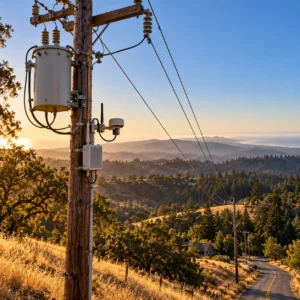
By 2042, the power grid could look radically different: decentralized, automated, and seamlessly integrated across generation, transmission, and distribution. The next two decades will mark a shift from traditional grid management to intelligent orchestration where human operators, artificial intelligence, and distributed energy resources act as a single adaptive ecosystem.
From Grid to Integrated Power Delivery System
The modern grid is already evolving under pressure. Distributed energy resources, electrification, cybersecurity risks, and extreme weather are converging to create new complexity. Historically, generation, transmission, and distribution have operated in silos. That model is breaking down.
Future power delivery systems will integrate these layers, aligning planning, operations, and markets in real time. The goal is not just efficiency but intelligence: an interconnected system that balances cost, reliability, safety, and sustainability.
Automation will sit at the core of this transformation. Layered AI controls will manage grid operations from local feeders and substations to regional transmission systems. As electrification accelerates and distributed resources multiply, automation will become essential. Human decision-making alone cannot keep up with the speed and variability of modern energy flows.
AI as the Grid’s New Brain
The grid of the future will operate as a federated cyber-physical system, optimized continuously through AI. Real-time analytics will enable instantaneous control decisions, balancing supply, storage, and demand across thousands of nodes.
Artificial intelligence will shift utilities from infrastructure providers to grid orchestrators. On a hot day with fluctuating solar output, AI will adjust flexible loads, storage dispatch, and protective controls far faster than humans could.
The move from static planning to continuous, scenario-based planning will redefine operations. Digital twins will simulate grid behavior, test outage responses, and guide procurement decisions, ensuring that system upgrades are data-driven and adaptive.
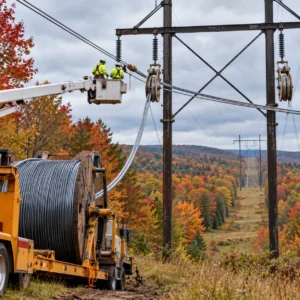
One day, autonomous field vehicles could handle storm restoration tasks or perform site inspections, eliminating many of today’s physical risks. The Feeder of the Future is both predictive and proactive, built to act faster than disruption itself.
Resilience by Design
Reliability alone will not be enough. The next-generation grid must be built to endure physical and digital threats. That means embedding resilience directly into design, eliminating single points of failure, and ensuring instant response to anomalies.
Instead of reacting to outages, the future grid will anticipate and prevent them. Outage duration, measured by the System Average Interruption Duration Index (SAIDI), could shrink from minutes to seconds.
Advanced automation, adaptive protection, and microgrid orchestration will isolate faults and reroute power instantly. Local energy resources will self-balance within seconds, keeping critical infrastructure online even when central systems are compromised.
The Feeder of the Future will redefine resilience as the ability to avoid disruption altogether, often before customers even notice an issue.
Data, Digital Twins, and Decentralized Control
A fully automated grid demands visibility. Digital twins, virtual replicas of the grid, will train AI algorithms using both real and synthetic data. This allows systems to learn from simulated outages, storms, and cyberattacks rather than real ones.
To operate safely, utilities will need to generate, process, and analyze vast amounts of data, potentially terabytes every day. Synthetic simulation will help build AI models with the equivalent of hundreds of years of operational experience.
This also requires computing power embedded at the grid edge. Edge compute nodes, secure communication layers, and hardened infrastructure will enable decentralized control at the feeder level. The challenge will be balancing innovation with affordability, ensuring modernization costs remain manageable for utilities and ratepayers.
Cybersecurity for a Quantum Ready Grid
As intelligence moves closer to the grid edge, so do vulnerabilities. Each new access point increases exposure to both physical and cyber threats. Traditional encryption may not withstand the computational power of next-generation AI or quantum computing.
The Feeder of the Future will therefore rely on real-time, adaptive security systems that detect and neutralize attacks dynamically. High-fidelity digital twins will act as a security mirror, scanning for irregularities, simulating countermeasures, and coordinating response before breaches propagate.
Artificial intelligence will continuously scan telemetry data, sensor feeds, and video surveillance to identify vulnerabilities. When attacks occur, AI-driven systems could coordinate both digital and physical responses, deploying software patches, drones, or robotic field units within minutes.
Security will no longer be static; it will evolve as fast as the threats it faces.
Transforming Work and the Customer Experience
Automation will redefine utility operations and workforce dynamics. Routine, reactive maintenance will give way to proactive oversight and strategic problem-solving. Employees will work alongside digital twins and AI tools, interpreting system insights rather than chasing outages.
Fewer truck rolls, safer field conditions, and optimized supply chains will improve operational efficiency and reduce costs. Training programs and change management will be critical to prepare employees for this digital shift.
For customers, the transformation will be equally profound. Local energy communities, clusters of homes, solar installations, and batteries, will function as semi-autonomous nano-grids. Real-time pricing, demand response, and peer-to-peer energy sharing will give consumers more control than ever before.
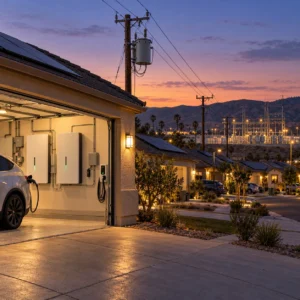
Plug and play integration will become standard. Connecting rooftop solar, home storage, or an EV charger could take minutes rather than weeks. Intelligent agents will automatically manage energy preferences, switching between grid and local resources for optimal cost and reliability.
Balancing Innovation and Realism
The vision for 2042 is bold, but transition speed will vary. While AI is already generating measurable returns in areas like vegetation management and distribution planning, scaling those systems across legacy infrastructure will take time.
Data architecture remains a foundational barrier. Utilities must invest in interoperable, scalable data systems capable of supporting automation and analytics. Without high-quality, well-governed data, advanced automation will remain theoretical.
Affordability will also shape the pace of progress. The modernization journey cannot depend solely on individual utility balance sheets. Third-party financing and public-private partnerships will play a vital role in spreading investment risk.
Utilities must balance quick wins, short-term AI use cases with clear ROI, against the long-term buildout of architecture, data, and cybersecurity. Transformation will be incremental but inevitable.
The Path Forward
The Feeder of the Future represents more than a technological upgrade; it is a reimagining of how energy flows through society. A grid that is intelligent, secure, and resilient will not just deliver electricity; it will orchestrate a complex ecosystem of devices, data, and distributed resources.
The transformation begins now. Building robust data governance, embedding AI safely, modernizing communication networks, and preparing the workforce are no-regret moves.
The power grid of 2042 will not be built overnight, but every strategic step taken today brings it closer to reality. The next-generation feeder will embody the evolution from infrastructure to intelligence, a grid capable of learning, adapting, and sustaining a fully electrified world.